MOSTLY
THOMAS
ADANK
ORDINARY


Text, Biography
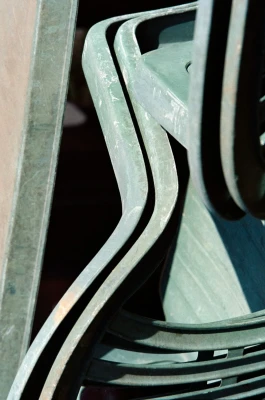
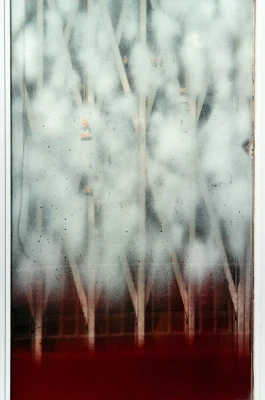
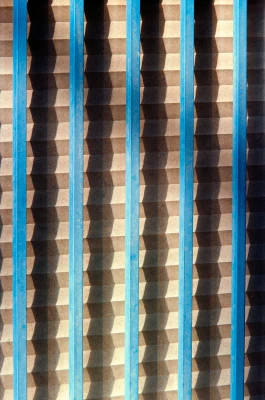
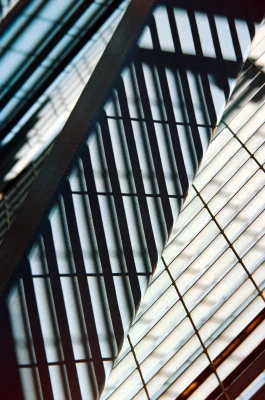
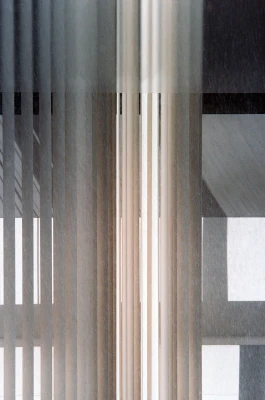
Mostly Ordinary explores the often overlooked details of the urban environment through a practice of drifting, where chance and intention intersect. The project focuses on abstract forms that emerge from the particular qualities of everyday objects and the interplay of light and material. These fleeting configurations reveal patterns and connections that might otherwise pass unnoticed or disappear. Made on analogue film, the images retain a material quality, with the grain of the print becoming part of how these fleeting details are registered and experienced.
The work considers the photograph and its frame as interdependent elements, where scale, edge, surface and position inform how the image relates to its environment. The frame extends beyond its conventional role as a support, connecting the photographic surface to the architecture of the display and to the viewer. Its industrial character draws on the language of utilitarian metalwork, recalling the functional components and exposed construction of everyday objects. A bespoke system of hooks provides a consistent means of holding the images, while each frame is developed as a variation on this simple element. Through this modular structure, images can be removed, rotated and reconfigured, allowing the work to take on different forms and establish new relationships over time.
The frames are the result of a collaboration with designer Alexandra Gerber, shaped by ongoing discussions about how to display images. The collaboration questions the conventional understanding of the frame as a separate structure around the image, exploring instead how it might become an integral element of the work.
Thomas Adank is a Swiss photographer based in London. His practice is built around the photographic detail, a way of describing the physical and conceptual singularities of the environments he records. Working across architecture, art and design, he collaborates closely with artists, architects, designers, galleries and institutions on the development of visual strategies for their work.
Adank studied Photography at ECAL and holds an MA in Photography from the Royal College of Art, London. He teaches photography at the Architectural Association, London.
Commissioned works and collaborations are available to view here.
All visual material presented on this website are original works by Thomas Adank ©2012–26. All rights reserved. These materials may not be reproduced, stored in a retrieval system, or transmitted in any form or by any means, in whole or in part, without the prior written consent of the copyright owner. Reform Grotesk from Forgotten Shapes. Design by Polytechnic.

London, 2025
C-print
80 × 53 cm.
31.5 × 20.9 in.
TA001

London, 2025
C-print
80 × 53 cm.
31.5 × 20.9 in.
TA002

London, 2025
C-print
80 × 53 cm.
31.5 × 20.9 in.
TA003

London, 2025
C-print
80 × 53 cm.
31.5 × 20.9 in.
TA004

Vevey, 2026
C-print
80 × 53 cm.
31.5 × 20.9 in.
TA005

La Tour-de-Peilz, 2026
C-print
80 × 53 cm.
31.5 × 20.9 in.
TA006

Athens, 2026
C-print
80 × 53 cm.
31.5 × 20.9 in.
TA007

London, 2026
C-print
80 × 53 cm.
31.5 × 20.9 in.
TA008

London, 2026
C-print
80 × 53 cm.
31.5 × 20.9 in.
TA009

London, 2026
C-print
80 × 53 cm.
31.5 × 20.9 in.
TA010

London, 2026
C-print
80 × 53 cm.
31.5 × 20.9 in.
TA011

London, 2026
C-print
80 × 53 cm.
31.5 × 20.9 in.
TA012

London, 2026
C-print
80 × 53 cm.
31.5 × 20.9 in.
TA013
THOMAS
MOSTLY
ADANK
ORDINARY


Text, Biography
Mostly Ordinary explores the often overlooked details of the urban environment through a practice of drifting, where chance and intention intersect. The project focuses on abstract forms that emerge from the particular qualities of everyday objects and the interplay of light and material. These fleeting configurations reveal patterns and connections that might otherwise pass unnoticed or disappear. Made on analogue film, the images retain a material quality, with the grain of the print becoming part of how these fleeting details are registered and experienced.
The work considers the photograph and its frame as interdependent elements, where scale, edge, surface and position inform how the image relates to its environment. The frame extends beyond its conventional role as a support, connecting the photographic surface to the architecture of the display and to the viewer. Its industrial character draws on the language of utilitarian metalwork, recalling the functional components and exposed construction of everyday objects. A bespoke system of hooks provides a consistent means of holding the images, while each frame is developed as a variation on this simple element. Through this modular structure, images can be removed, rotated and reconfigured, allowing the work to take on different forms and establish new relationships over time.
The frames are the result of a collaboration with designer Alexandra Gerber, shaped by ongoing discussions about how to display images. The collaboration questions the conventional understanding of the frame as a separate structure around the image, exploring instead how it might become an integral element of the work.
Thomas Adank is a Swiss photographer based in London. His practice is built around the photographic detail, a way of describing the physical and conceptual singularities of the environments he records. Working across architecture, art and design, he collaborates closely with artists, architects, designers, galleries and institutions on the development of visual strategies for their work.
Adank studied Photography at ECAL and holds an MA in Photography from the Royal College of Art, London. He teaches photography at the Architectural Association, London.
Commissioned works and collaborations are available to view here.
All visual material presented on this website are original works by Thomas Adank ©2012–26. All rights reserved. These materials may not be reproduced, stored in a retrieval system, or transmitted in any form or by any means, in whole or in part, without the prior written consent of the copyright owner. Reform Grotesk from Forgotten Shapes. Design by Polytechnic.

London, 2025
C-print
80 × 53 cm.
31.5 × 20.9 in.
TA001

London, 2025
C-print
80 × 53 cm.
31.5 × 20.9 in.
TA002

London, 2025
C-print
80 × 53 cm.
31.5 × 20.9 in.
TA003

London, 2025
C-print
80 × 53 cm.
31.5 × 20.9 in.
TA004

Vevey, 2026
C-print
80 × 53 cm.
31.5 × 20.9 in.
TA005

La Tour-de-Peilz, 2026
C-print
80 × 53 cm.
31.5 × 20.9 in.
TA006

Athens, 2026
C-print
80 × 53 cm.
31.5 × 20.9 in.
TA007

London, 2026
C-print
80 × 53 cm.
31.5 × 20.9 in.
TA008

London, 2026
C-print
80 × 53 cm.
31.5 × 20.9 in.
TA009

London, 2026
C-print
80 × 53 cm.
31.5 × 20.9 in.
TA010

London, 2026
C-print
80 × 53 cm.
31.5 × 20.9 in.
TA011

London, 2026
C-print
80 × 53 cm.
31.5 × 20.9 in.
TA012

London, 2026
C-print
80 × 53 cm.
31.5 × 20.9 in.
TA013

Biography
Thomas Adank is a photographer living and working in London. His practice focuses primarily on the photographic detail as a means to describe the physical and conceptual singularities of the environments he records. He studied photography at ECAL in Switzerland and obtained a Masters of Art at the Royal College of Art in London.
He has been working collaboratively with artists, architects, designers, galleries and institutions on the development of visual strategies for communicating work made in the fields of architecture, art and design.
He lectures at the Architectural Association School of Architecture and Camberwell College of Arts in London.
Contact
For commissioned work
and collaborations, please
enquire here.
All visual material presented on this website are original works by Thomas Adank ©2012–26. All rights reserved. These materials may not be reproduced, stored in a retrieval system, or transmitted in any form or by any means, in whole or in part, without the prior written consent of the copyright owner. Reform Grotesk from Forgotten Shapes. Design by Polytechnic.